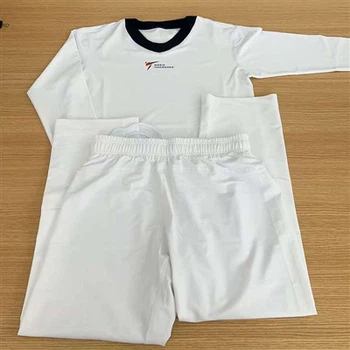
In the arena of mixed martial arts and Brazilian Jiu-Jitsu, a set of well-fitting Jiu-Jitsu uniforms is not only an essential equipment for athletes, but also the core carrier of technical performance and cultural inheritance. With the popularity of fighting sports around the world, the design and function of Jiu-Jitsu uniforms are also constantly evolving, becoming an invisible link between athletes, coaches and spectators.
Functional design determines competitive performance
Jiu-Jitsu uniforms are usually made of high-density cotton fabrics, which are both wear-resistant and breathable. Its tailoring focuses on flexibility, and the tightening design of cuffs and trouser legs can prevent opponents from grabbing without affecting joint movement. Some high-end Jiu-Jitsu uniforms will add micro-elastic fibers to reduce the interference caused by clothing displacement in fierce fighting. It is worth noting that international Jiu-Jitsu competitions have strict regulations on clothing sizes-tops must completely cover the waist to the clavicle, and the length of pants must touch the ankles to ensure fair competition.
Cultural symbols and identity
The color matching and patterns of Jiu-Jitsu uniforms often carry the sense of belonging of athletes. Dark blue symbolizes calmness, black represents senior rank, and white is the symbol of beginners. Many players will embroider national flags or personal badges on their cuffs, which not only highlights national honor but also conveys personal style. In Brazil, traditional hand-sewn jiu-jitsu uniforms are even regarded as works of art, and some family workshops continue the production process for more than a hundred years.
Quality challenges in the foreign trade market
For export companies, jiu-jitsu uniforms must meet multiple standards at the same time: they must pass the friction coefficient test of the International Judo Federation (IBJJF) and adapt to the washing needs of different climate zones. In recent years, the application of environmentally friendly dyes and antibacterial treatment technologies is driving the industry's transformation to sustainable development. Data shows that the demand for lightweight training uniforms in Southeast Asia and Europe has increased by 17% annually, reflecting the expansion of the amateur community.
From the arena to the global supply chain, the story of jiu-jitsu uniforms is far more than a piece of cloth. It is the practical result of ergonomics, the intuitive expression of fighting aesthetics, and a microscopic incision of the globalization of sports business. With the rise of e-sports and virtual training, jiu-jitsu uniforms may also incorporate intelligent sensing technology in the future to open up a new dimension of sports equipment.